

Direct guidance with the important conditions beside it.
These answers help frame a first discussion. Concealed conditions, product instructions, and the actual electrical scope still need project-specific confirmation.
Planning and layout
How many pot lights does a room need?
There is no universal quantity. Room dimensions, ceiling height, fixture output and beam, finishes, walls, work surfaces, furniture, and control zones all affect the useful layout.
How far apart should pot lights be?
Spacing follows beam overlap and the target surfaces. A number that works for one fixture, height, and room may be wrong for another.
How far should pot lights be from a wall?
It depends on whether the goal is general coverage, wall wash, artwork, cabinets, or circulation. Beam angle and ceiling height change the result.
Can pot lights be installed in a finished ceiling?
Often, yes. Joist direction, ducts, pipes, insulation, cable routes, rooms above, and available openings determine the practical method.
Ceilings and access
Can zero drywall damage be guaranteed?
Not responsibly before concealed conditions are understood. Some routes work through fixture openings; other routes need limited extra access. The quote should state repair boundaries.
Does attic access help?
Accessible attic space can create routing options, but insulation, vapour barriers, obstructions, working conditions, and the intended fixture locations still matter.
Are slim canless lights always the best choice?
No. They are useful in shallow or obstructed cavities, but beam quality, glare, driver access, insulation suitability, serviceability, and product quality also matter.
What is the difference between 4-inch and 6-inch pot lights?
Aperture size can affect appearance, output options, beam, glare, and fit. Product performance matters more than diameter alone.
Fixtures, LEDs, and controls
Should I choose fixed or gimbal fixtures?
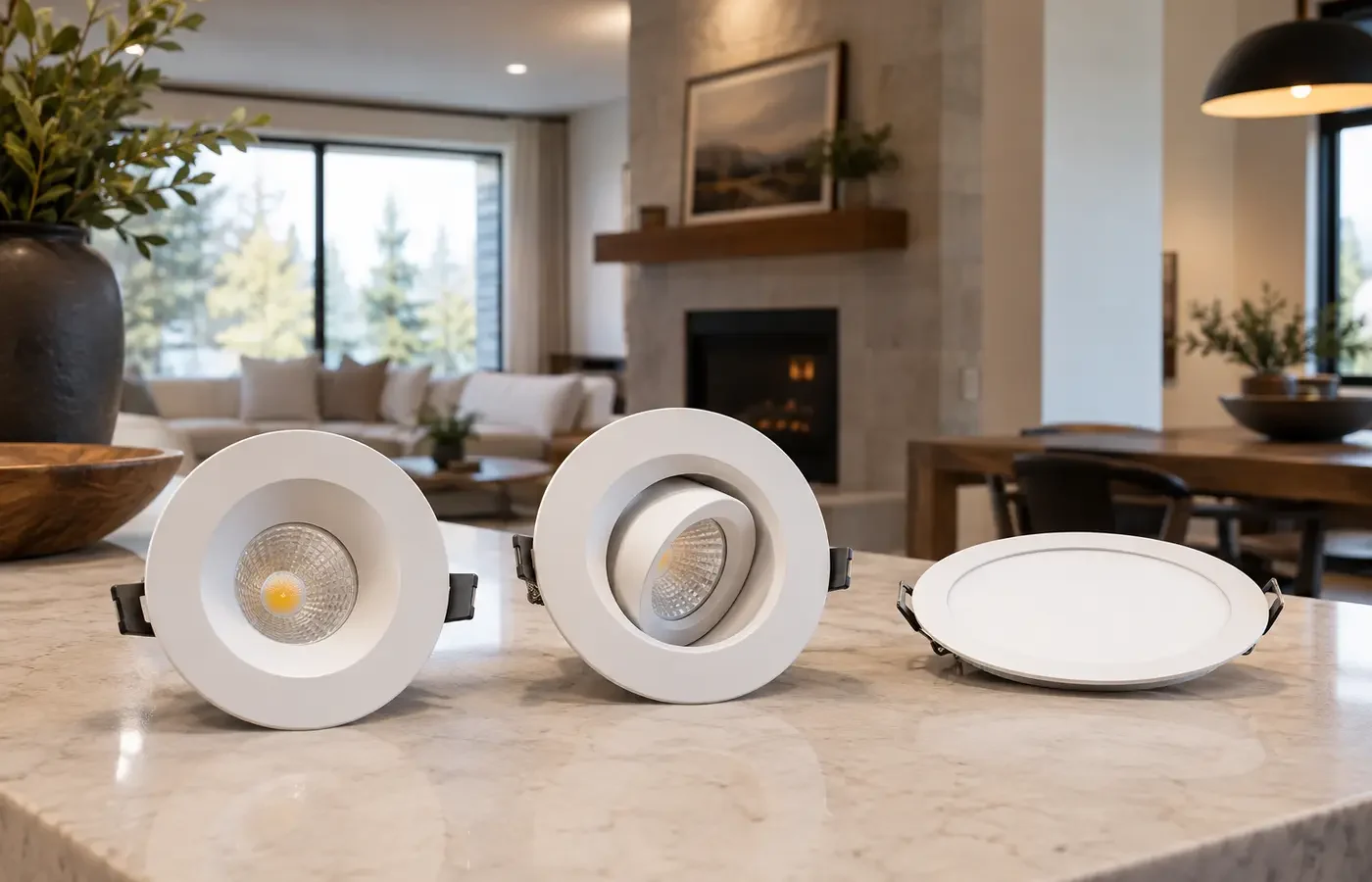
Fixed downlights suit direct general or task coverage. Gimbals help aim toward walls, art, slopes, or off-axis features when a directional beam is useful.
Is 3000K or 4000K better?
3000K is a common warm-neutral residential choice; 4000K looks cooler. Compare finishes, daylight, adjacent rooms, CRI, and preference rather than using one universal rule.
What is CRI?
Colour Rendering Index is one measure of how a light source renders colours compared with a reference. Kelvin describes colour appearance; it does not replace colour-quality information.
Should connected rooms use the same colour temperature?
Visible connected spaces usually benefit from deliberate coordination. Enclosed rooms can differ when the choice is intentional.
Why do LED pot lights flicker?
Possible causes include driver and dimmer incompatibility, load range, wiring, connection, product condition, supply, or control settings. The symptom requires diagnosis.
Why do LED lights buzz?
Sound may come from the dimmer, driver, lamp, transformer, or fixture. Compatibility, load, product condition, and mounting can all contribute.
Why do lights glow when switched off?
Small leakage current, control electronics, wiring arrangements, or driver sensitivity may be involved. A qualified assessment should identify the system cause.
Can old halogen pot lights be converted to LED?
Often, but identify the housing, opening, lamp base, transformer or driver, insulation relationship, and dimmer before selecting a lamp, module, or new fixture.
Can one mismatched fixture be replaced?
Sometimes. An exact trim, tint, Kelvin, output, and dimming match may be unavailable, so review the entire visible zone before choosing.
Exterior lighting
What makes an exterior fixture suitable?
Use an electrical product approved for use in Ontario and rated for the actual damp or wet exposure and installation orientation. Verify the label and instructions.
Can exterior lights shine toward a neighbour?
Mississauga says exterior lights should not shine directly into another property. Aim, shield, and limit output so light remains useful on the property.
Should soffit lights stay on all night?
Not automatically. Timers, photocells, sensors, and schedules can preserve useful coverage while reducing unnecessary brightness.
Ontario electrical process
Do pot lights require an ESA notification?
ESA states almost all electrical work requires a notification, with limited exceptions. The responsible Licensed Electrical Contractor should confirm and file it when required.
Is an ESA notification the same as a building permit?
No. ESA explains that an electrical notification and a municipal building permit are separate. A broader renovation may need both.
Who may offer electrical installation work in Ontario?
ESA states that a Licensed Electrical Contractor is the business authorized to offer electrical work to the public. Customers can ask for and verify the ECRA/ESA licence.
Estimates and next steps
What should a pot-light estimate include?
Look for fixture details, layout and quantity, wiring, controls, ceiling access, notification responsibility, cleanup, tax, finishing boundaries, exclusions, and a change process.
What photos help with an estimate?
Send wide room or exterior views, the full ceiling, important surfaces, existing fixtures and controls, access clues, close-up labels, and any selected product links.
How long does installation take?
Timing varies with quantity, access, ceiling construction, wiring, controls, height, product assembly, inspection needs, and finishing. Confirm it after the scope is understood.
Still deciding what applies to your project?
Share the room, ceiling, exterior area, or fixture you want to improve. Photos and approximate dimensions are useful, but you do not need every technical detail before getting in touch.