
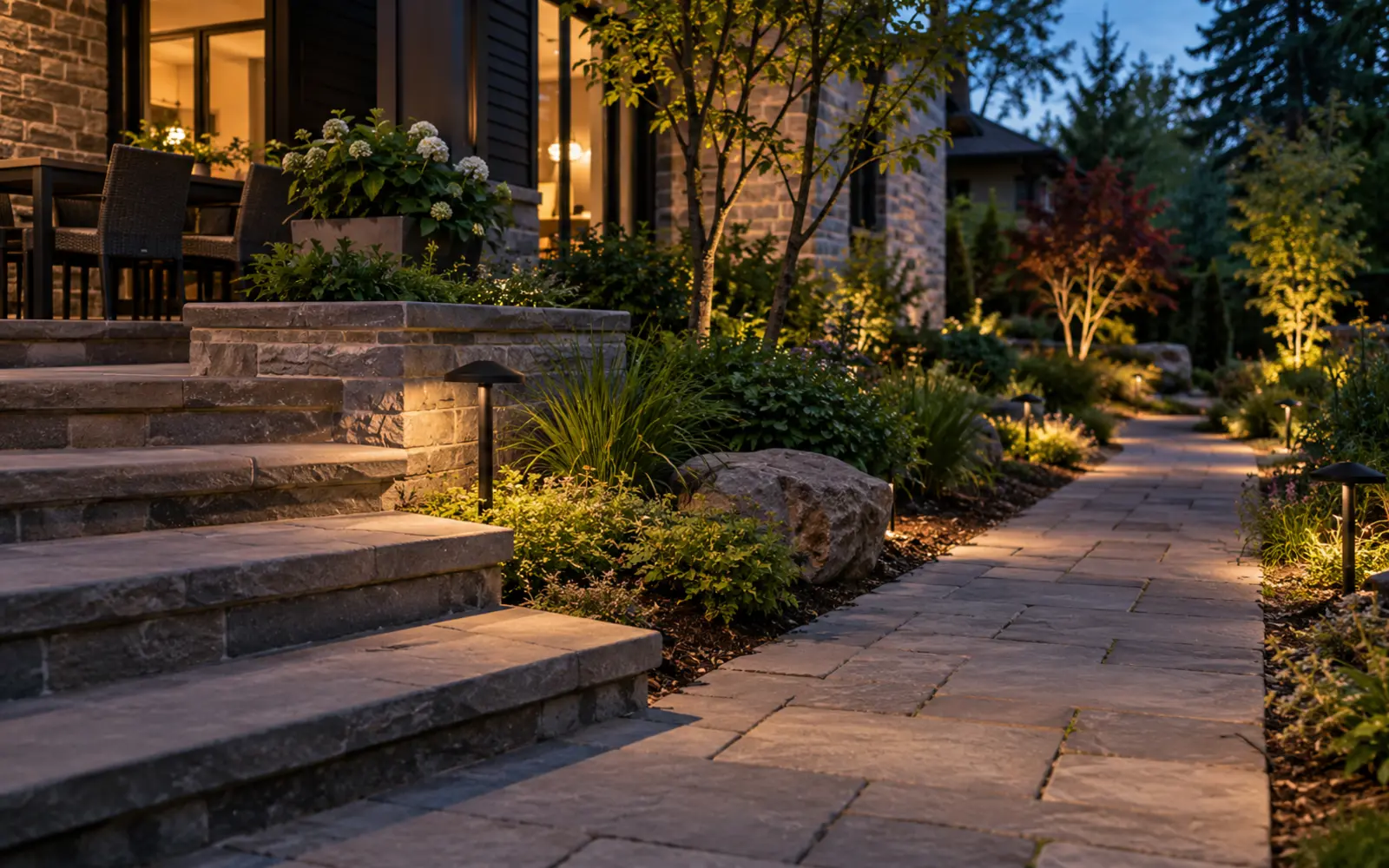
How should outdoor lighting be planned?
Begin with the nighttime task: finding the door, seeing a step, moving along a path, using a patio, identifying an address, or revealing selected planting. Then choose a fixture and mounting position that puts enough light on that task without exposing a bright source.
Low-voltage landscape systems and line-voltage building fixtures have different products, wiring, transformer, circuit, and notification considerations. The scope should distinguish them and confirm weather suitability, cable routes, controls, aiming, and maintenance access.
Give every exterior fixture a job.
Porch and address
Support entry, locks, numbers, and faces without glare at the doorway.
Steps and paths
Use low, shielded coverage to reveal edges and direction.
Patio and seating
Combine useful task light with comfortable low-level ambience.
Garden and architecture
Selectively reveal texture or planting rather than lighting every surface.
Outdoor light must survive and stay aimed.
Weather, landscape growth, snow, glare, maintenance, and property boundaries change the plan after installation.
| Condition | Why it changes the plan |
|---|---|
| Location rating | Products must suit the actual damp or wet exposure and installation orientation. |
| Low versus line voltage | Changes transformers, cable, controls, electrical scope, and expansion options. |
| Shielding and aiming | Keep the source out of normal sightlines and direct light toward the intended surface. |
| Cable and transformer access | Affects routing, protection, voltage drop, maintenance, and future changes. |
| Seasonal conditions | Snow reflection, freeze-thaw, moisture, leaves, and plant growth change performance. |
| Controls | Timers, photocells, sensors, and smart schedules need a clear priority and override plan. |
Map fixtures, cable, power, and control.
A useful exterior quote should identify the complete system and how it will be adjusted after dark.
- Fixture types, quantity, output, beam, shielding, colour temperature, and location suitability
- Exact target areas, mounting positions, aiming, and areas intentionally left dark
- Line-voltage circuit or low-voltage transformer, capacity, cable route, and protection
- Control sequence for switch, timer, photocell, sensor, or connected device
- Access, excavation or surface work, landscape restoration, and future maintenance
- Notification responsibility, nighttime aiming, testing, cleanup, tax, and documentation
Use the lowest effective brightness.
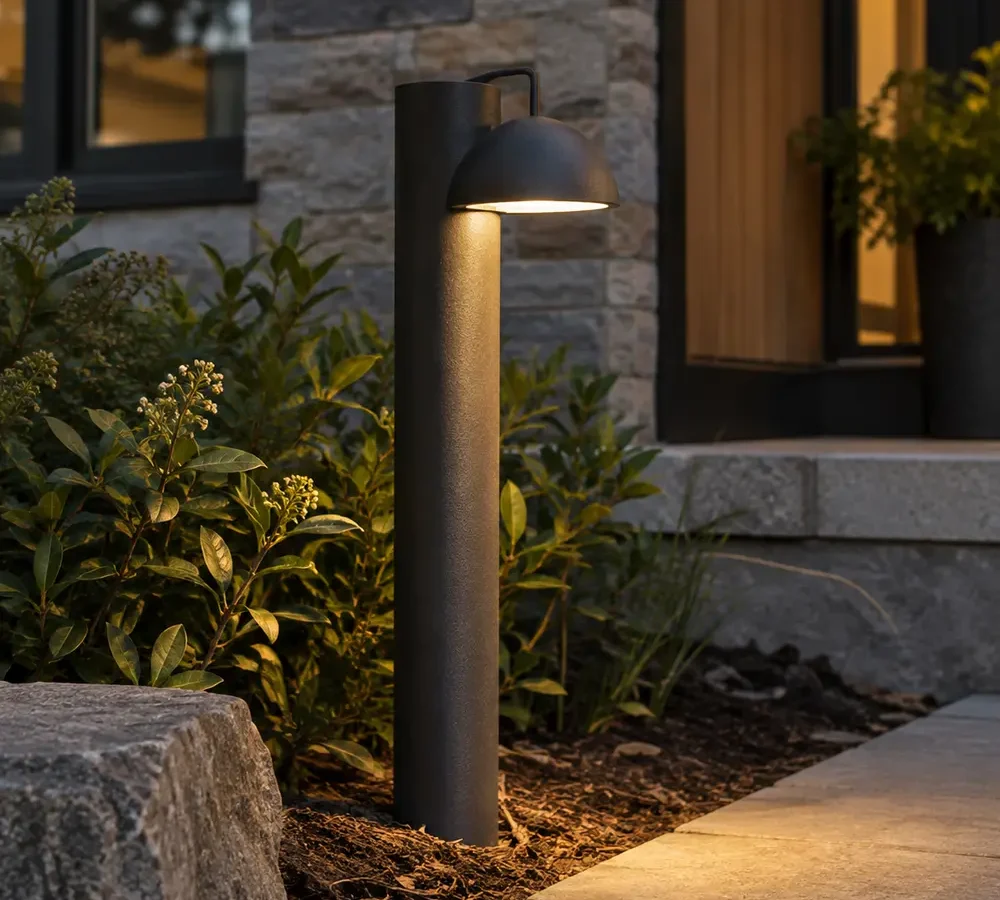
Shielded path light
Directs light to the walking surface instead of into approaching eyes.
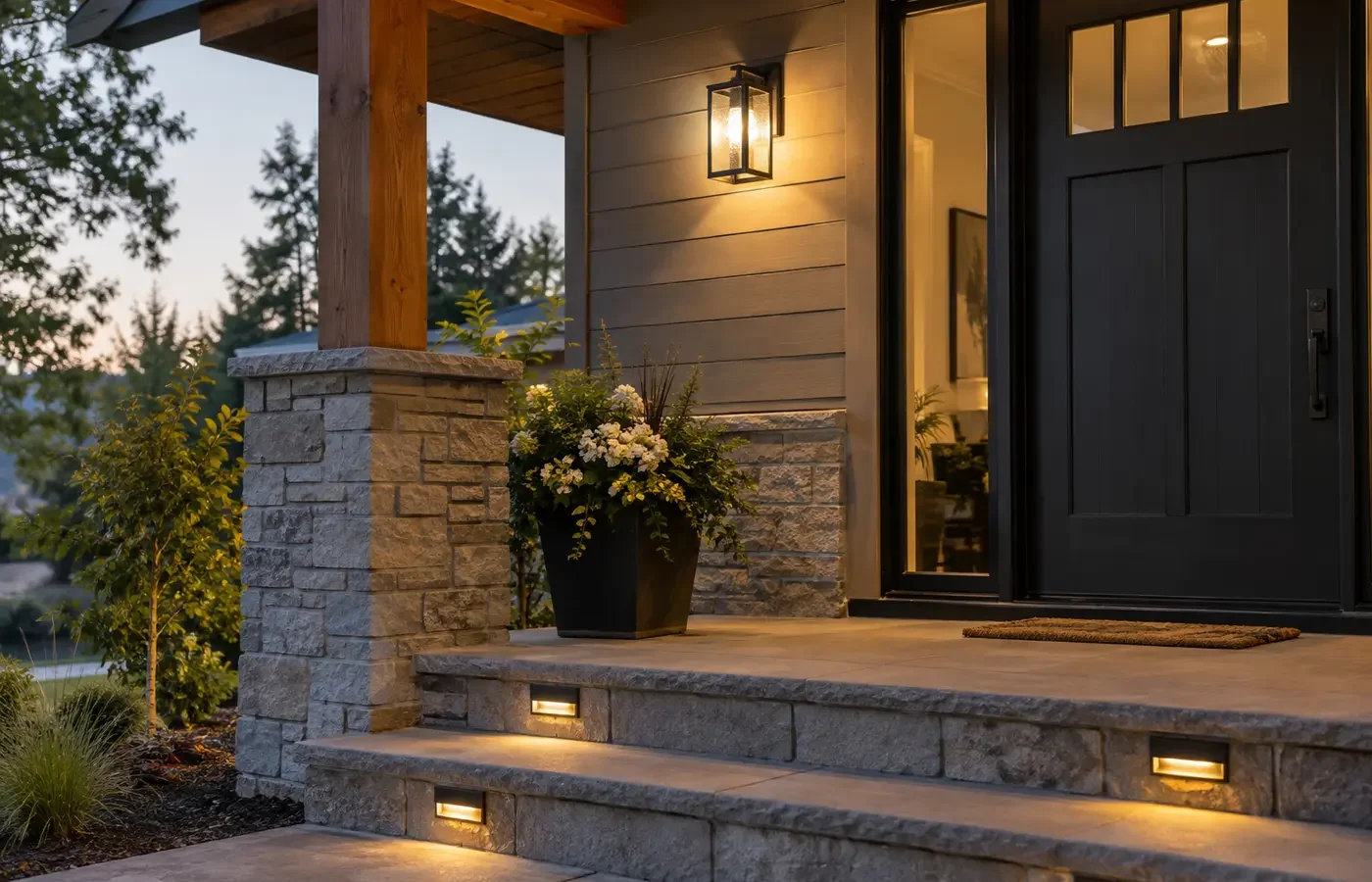
Downward porch light
Supports the door, step, and address while reducing upward and outward spill.
Selective accent light
Uses a narrow, controlled target rather than flooding an entire garden or façade.
Move from the goal to a confirmed scope.
Document the starting point
Begin with daylight and evening photographs of each target area and approximate path, garden, porch, and patio distances.
Review the conditions
Work through location rating, low versus line voltage, product suitability, access, and control before fixing the scope.
Compare written inclusions
Confirm fixture types, quantity, output, beam, shielding, colour temperature, and location suitability plus the access, finishing, notification, testing, and change assumptions.
Coordinate the next step
Share Property Photos once the important unknowns and responsibilities are visible.
Keep exterior light on the property.
Mississauga says exterior lights should not shine directly into another property. Review neighbouring windows and likely viewing angles before setting output or aiming. See the City nuisance-lighting by-law.
Suitable products and an authorized electrical contractor are required for the applicable electrical work. Confirm the difference between low-voltage product installation, line-voltage electrical work, ESA notification, and any broader municipal requirements.
Answers before you compare the scope.
How bright should path lights be?
Use enough controlled light to reveal the walking surface and edges. Mounting, spacing, shielding, ambient darkness, snow, and surface reflectance matter more than one wattage.
Where can the transformer go?
In a suitable, accessible location that supports cable routes, ventilation, weather protection, capacity, controls, and future service.
Are motion controls appropriate?
They can be useful for selected security or access areas. Avoid abrupt over-brightness and nuisance triggers by planning sensitivity, duration, and base lighting.
What needs wet-location suitability?
The actual exposure and installation instructions determine suitability. Do not infer a rating from the fixture’s appearance.
Continue with the closest lighting decision.
Exterior Eave Lighting
Plan soffit rhythm, roofline access, product rating, and glare.
Explore this topic →
Dimmers & Controls
Review timers, sensors, photocells, and connected schedules.
Explore this topic →
Troubleshooting
Investigate failed exterior drivers, moisture, controls, or mismatched products.
Explore this topic →
Tell us about the space and the result you want.
For a useful first review, provide daylight and evening photographs of each target area, approximate path, garden, porch, and patio distances, and the outcome you want. Add product links or close-up photographs when they clarify the existing condition.