
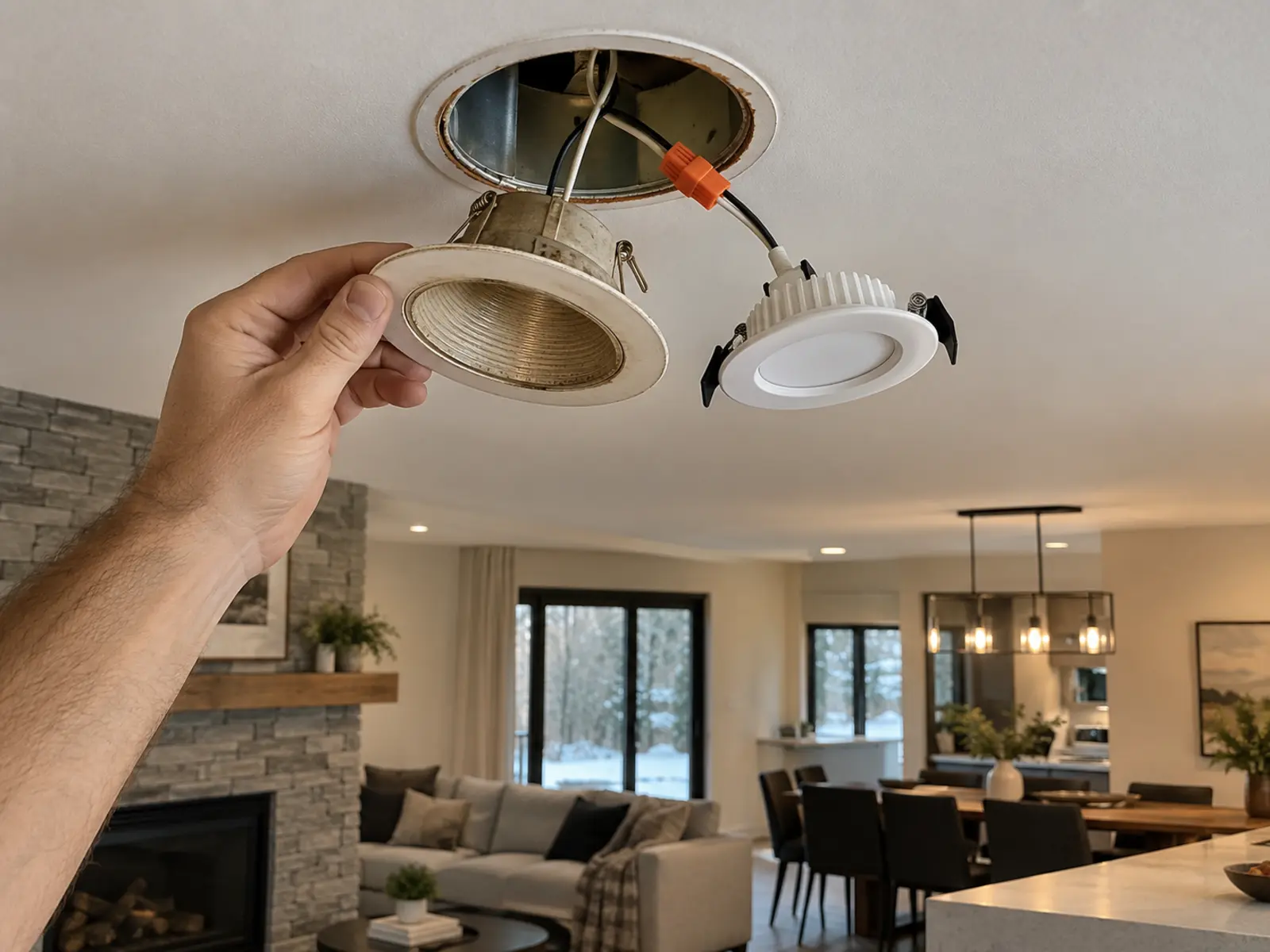
Can old recessed lights be converted to LED?
Often, but the correct method depends on the existing housing, opening size, lamp base, trim, wiring, insulation relationship, and condition. Some systems accept a compatible lamp or retrofit module; others are better treated as a new fixture installation.
Photograph the fixture from below, the trim removed where safely accessible, any label, the driver or transformer, and the existing dimmer. Matching colour and output across a visible ceiling is usually more useful than replacing one failed light with the closest-looking product.
Choose the smallest suitable intervention.
Lamp replacement
May suit a sound compatible housing when the base, size, rating, output, and control all align.
Retrofit module
Can refresh trim and light source together when the listed compatibility and opening fit are confirmed.
Slim fixture conversion
May be appropriate when the old system is removed and wiring, junction, access, and ceiling opening are addressed.
Coordinated ceiling update
Prioritizes matching appearance, colour, output, and dimming across the visible space.
Existing components determine compatibility.
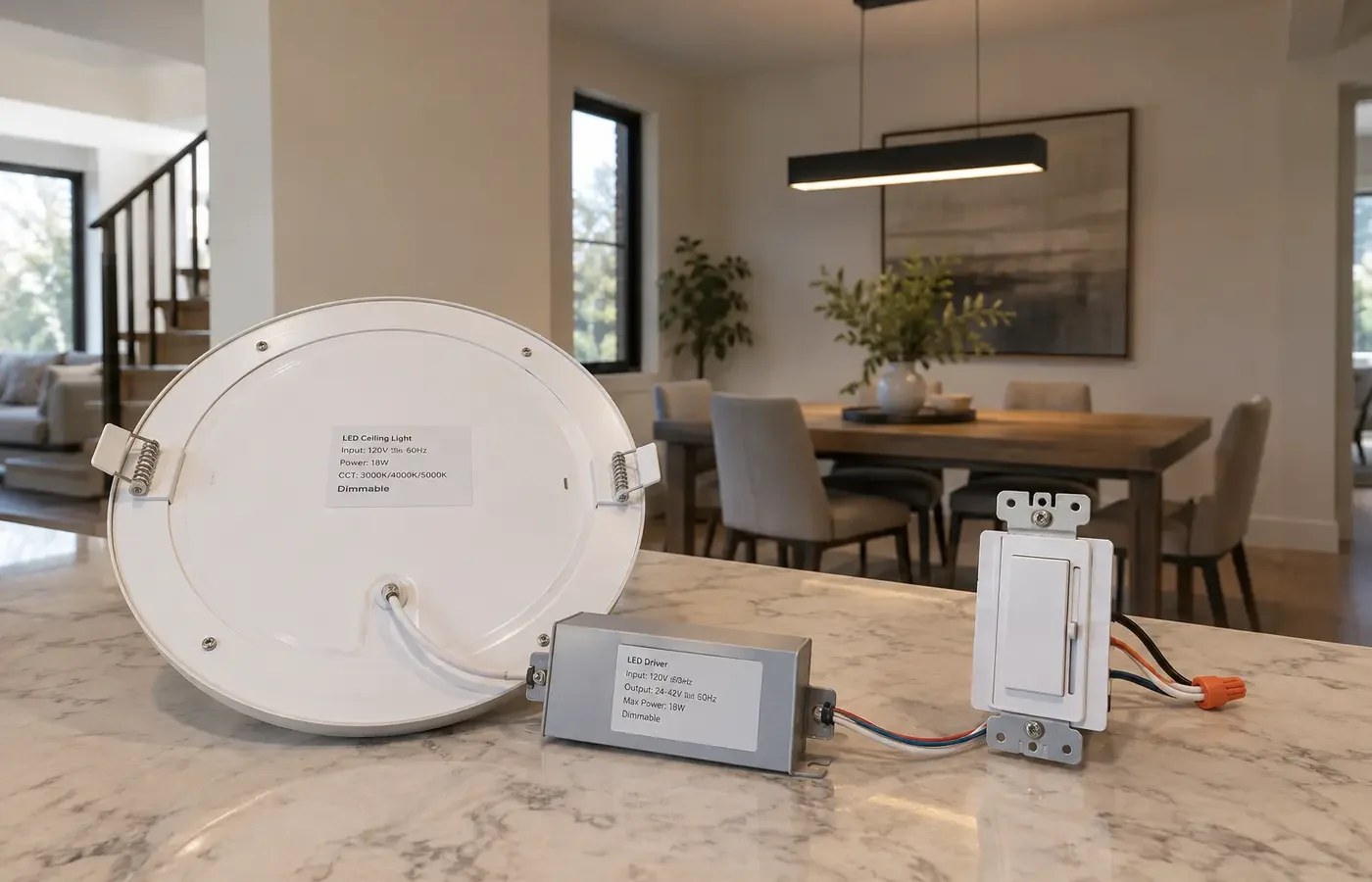
The visible trim reveals only part of the system. Driver electronics, control, wiring, and housing conditions can change the replacement choice.
| Condition | Why it changes the plan |
|---|---|
| Housing and opening | Determine what physically fits and whether the existing enclosure remains part of the approved system. |
| Driver or transformer | May be separate, integrated, incompatible with a new source, or the actual point of failure. |
| Dimmer | Older or mismatched controls can cause flicker, buzz, glow, limited range, or unstable low levels. |
| Colour consistency | Kelvin, tint, CRI, age, and manufacturer variation affect whether replacements look coordinated. |
| Insulation and heat | Fixture suitability and installation instructions must match the ceiling condition. |
| Serviceability | Future access to drivers, junctions, and replacement products belongs in the decision. |
Record what stays, what changes, and what must match.
A replacement quote should name the existing system assessment and the exact proposed method.
- Existing housing, lamp, trim, driver, transformer, opening, and control observations
- Replacement model, fit method, approval, output, beam, colour temperature, and trim
- Whether all visible fixtures or only failed units are replaced
- Dimmer compatibility, low-end performance, switching, and any control changes
- Ceiling-opening adjustments, wiring work, patching, disposal, and cleanup
- Notification responsibility, testing, documentation, warranty wording only if verified

Think beyond lower wattage.
Visual consistency
Matching trims and light colour can improve a room more than replacing individual failures one at a time.
Control performance
A compatible dimmer and driver pair can matter as much as the LED module itself.
Future service
Accessible drivers and identifiable products make later diagnosis and replacement more practical.
Move from the goal to a confirmed scope.
Document the starting point
Begin with wide photograph showing all existing lights together and close-ups of trim, lamp, label, driver, or transformer.
Review the conditions
Work through housing and opening, driver or transformer, product suitability, access, and control before fixing the scope.
Compare written inclusions
Confirm existing housing, lamp, trim, driver, transformer, opening, and control observations plus the access, finishing, notification, testing, and change assumptions.
Coordinate the next step
Send Fixture Photos once the important unknowns and responsibilities are visible.
Treat local context as a project condition, not a keyword.
For Recessed Light Replacement & LED Modernization, a Mississauga address alone does not reveal the ceiling, wiring, structure, permissions, or access. Property type is useful because it prompts better questions about housing and opening and driver or transformer; the actual conditions still need confirmation.
Ontario electrical installation work offered to the public must be handled through a Licensed Electrical Contractor. ESA explains that almost all electrical work requires a notification, with limited exceptions. The responsible contractor should confirm the requirement, file when required, and provide the accepted-work documentation.
Answers before you compare the scope.
Can existing housings stay?
Sometimes. Their condition, size, type, lamp base, listing, insulation relationship, and compatibility with the intended retrofit must be confirmed.
Why do new LEDs flicker on an old dimmer?
The dimmer, driver, electrical load, wiring, or product combination may be incompatible even if the lights turn on.
Can one mismatched light be replaced?
It can, but an exact visual and colour match may be unavailable. Compare the whole visible ceiling before deciding.
What photos are useful?
Send the full ceiling, one fixture close-up, the trim removed only when safely accessible, labels, driver or transformer, and wall control.
Continue with the closest lighting decision.
Troubleshooting & Repairs
Separate a failed component from a broader compatibility issue.
Explore this topic →
Dimmers & Controls
Review LED stability, load, wiring, and desired behaviour.
Explore this topic →
3000K vs 4000K
Compare colour temperature, CRI, finishes, and connected spaces.
Explore this topic →
Tell us about the space and the result you want.
For a useful first review, provide wide photograph showing all existing lights together, close-ups of trim, lamp, label, driver, or transformer, and the outcome you want. Add product links or close-up photographs when they clarify the existing condition.